
Growth in Colombia's I-REC market was steady in 2023, as the country continues to make use of its extensive hydro resources alongside a competitive landscape with local renewable certificates.
Key figures, vintage 2023
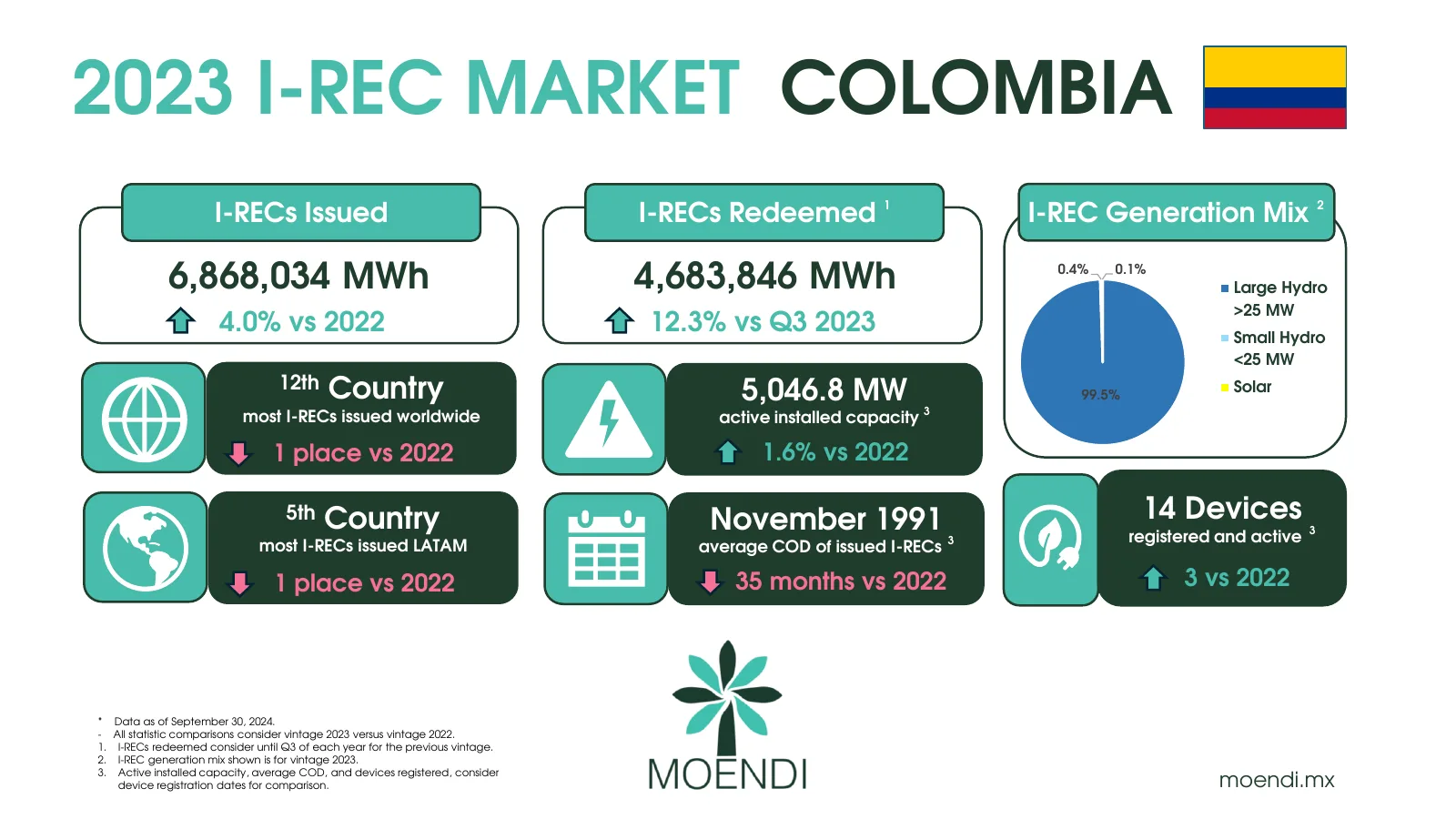
I-RECs issued
6,868,034 MWh
+4.0% vs 2022
I-RECs redeemed
4,683,846 MWh
+12.3% vs 2022
Worldwide rank
12th
Down 1 place vs 2022
Latin America rank
5th
Down 1 place vs 2022
Active installed capacity
5,046.8 MW
+1.6% vs 2022
Devices registered and active
14
+3 vs 2022
Average COD of I-RECs issued
November 1991
35 months older than 2022
Generation mix of I-RECs issued
- Large hydro (>25 MW) 99.5%
- Small hydro (<25 MW) 0.4%
- Solar 0.1%
Consistent growth
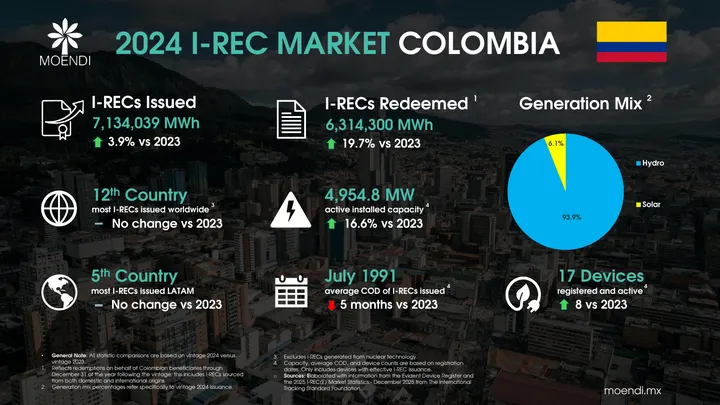
Colombia issued 6,868,034 MWh of I-RECs for the 2023 vintage, a modest 4.0% increase from 2022. Redemptions grew faster, up 12.3% to 4,683,846 MWh, as more companies actively commit to their sustainability goals. Certificates are issued by ECSIM.
A regional competitor
Ranked 12th globally and 5th in Latin America for I-REC issuance, Colombia plays a significant role in the region's renewable energy transition. The presence of local certificates has limited the expansion of the I-REC market, adding an interesting dynamic to Colombia's energy attribute certificate (EAC) landscape.
Hydro-powered dominance
Colombia's I-REC issuance is overwhelmingly driven by hydro, which accounts for 99.9% of the 2023 total, thanks to a landscape rich in rivers and high-altitude locations ideal for hydroelectric plants. Large hydro (over 25 MW) provides 99.5%, small hydro (under 25 MW) 0.4% and solar 0.1%. Recent registrations show early signs of interest in solar as an alternative.
The average commercial operation date of the certificates issued is November 1991, reflecting the long operating history of the country's hydro fleet.
What it means for buyers
With a strong foundation in hydroelectric power, Colombia's renewable energy landscape continues to progress, if more gradually than its neighbors. Despite competition from local certificates, its steady I-REC growth highlights its potential in the Latin American renewable energy sector.